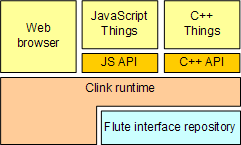
Thing Browser
Thing Browser was a project proposal I made early on in my tenure at Google, to recast the Web as a network of user composable distributed objects.
The inspiration
As I describe under FavaBeans, I am a big fan of object-oriented user interfaces. I expected the Web to be the most popular platform for distributed computing, and it was natural to imagine that each URL identifies a distributed object.
What if we could build these ideas into a Web browser, in such a way that plain HTML Web pages are just very simple distributed objects?
My project used some tech that was popular at the time: Java Web Start to launch applications, and OSGi to distribute software modules.
What we got working
My friend Mahlen Morris suggested a movie editor as a way to make “Ken Burns animations” out of Web content and republish it as Web content, and another friend with experience in bioinformatics made a “protein molecule” viewer that plugged into the system. I made handlers for common media formats like images, sound clips, plain Web pages, and a few other things.
The result was an iMovie-like interface allowing a variety of Web and Java resources to be remixed into an animation. It could accept as audio or visual “tracks” any objects that supported the necessary Facets.
Sadly, no screenshots or easily workable prototypes of the actual code survive, but it was a really cool UI, and the “Ken Burns animation” concept proved to be a really nice way to demonstrate how content interoperability could lead to novel “application” innovation.
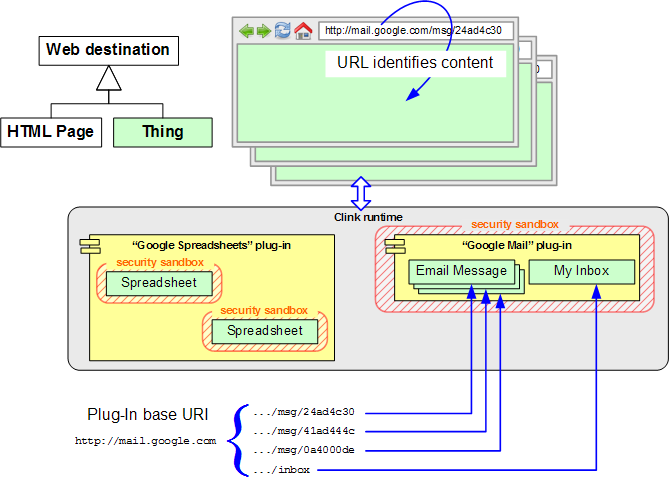
The internal implementation of the Thing Browser framework provided an interface discovery framework (similar to IUnknown in Microsoft COM) to discover supported Facets. Groups of URLs were mapped to OSGi bundles which were dynamically composed into the system. Each bundle had a URL handler which would return an object that the framework could then display.
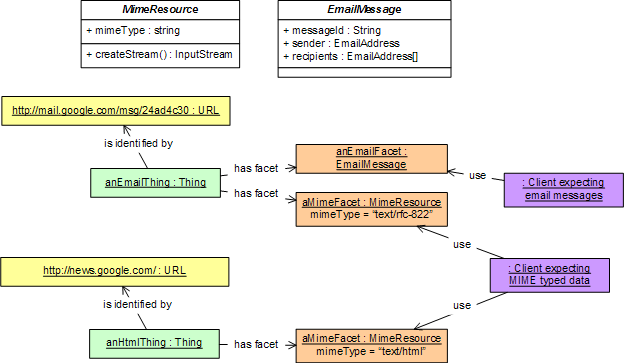
The whole thing would be bound together by an “interface repository”: